
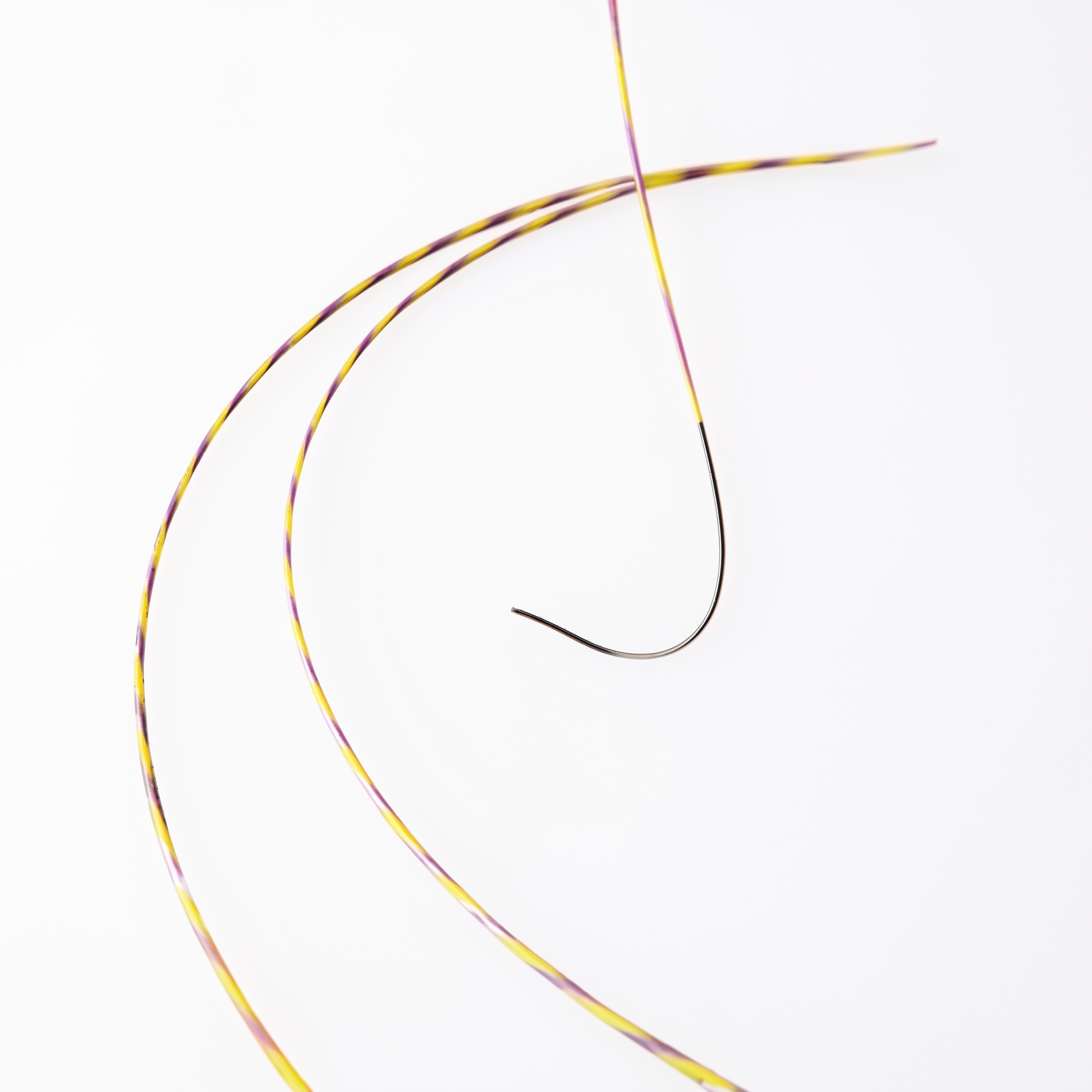
Application
Used to assist in the insertion of an endoscope or endotherapy devices, (e.g., stent-placement devices, electrosurgical devices, or catheters) during diagnostic and therapeutic endoscopy
Specification
| Tip Type | Max. O.D. | Working Length ± 50 (mm) | |
| ± 0.004 (inch) | ± 0.1 mm | ||
| Angle | 0.025 | 0.63 | 2600 |
| Angle | 0.025 | 0.63 | 4500 |
| Straight | 0.025 | 0.63 | 2600 |
| Straight | 0.025 | 0.63 | 4500 |
| Angle | 0.035 | 0.89 | 2600 |
| Angle | 0.035 | 0.89 | 4500 |
| Straight | 0.035 | 0.89 | 2600 |
| Straight | 0.035 | 0.89 | 4500 |
| Angle | 0.025 | 0.63 | 2600 |
| Angle | 0.025 | 0.63 | 4500
|
Instructions for Use
Intended Use
The KINDMED™ ERCP Guidewire is intended to facilitate the introduction, positioning, and exchange of diagnostic or therapeutic devices during endoscopic and interventional procedures involving the biliary and pancreatic ductal systems.
The guidewire is designed to assist selective cannulation, navigation through strictures, and placement of compatible accessories during ERCP procedures.
The device is supplied sterile and intended for single-patient use only.
Indications for Use
The KINDMED™ ERCP Guidewire is indicated for:
- Cannulation of the biliary ductal system.
- Cannulation of the pancreatic duct.
- Guidewire-assisted ERCP procedures.
- Crossing and bridging ductal strictures.
- Placement and exchange of compatible endoscopic accessories.
Device Description
The KINDMED™ ERCP Guidewire is a flexible, steerable guidewire intended for use with compatible endoscopic accessories and therapeutic devices.
The guidewire is designed to provide:
- Controlled navigation through ductal anatomy.
- Enhanced access to target locations.
- Support for device exchange procedures.
- Compatibility with wire-guided ERCP accessories.
The device incorporates a flexible distal segment to assist atraumatic advancement while maintaining sufficient proximal support for procedural control.
Target Patient Population
The device is intended for patients requiring diagnostic or therapeutic biliary or pancreatic interventions as determined by the treating physician.
No specific restrictions are associated with age, gender, or patient population provided the clinical anatomy permits safe use of the device.
Use in pediatric, pregnant, or breastfeeding patients should be based on physician assessment of the anticipated benefits and potential risks.
Shelf Life
The product has a shelf life of three (4) years from the date of manufacture when stored under recommended storage conditions.
Contraindications
The device is contraindicated in situations where ERCP procedures are contraindicated or where guidewire-assisted access is not clinically appropriate.
The treating physician should evaluate patient suitability before use.
Potential Adverse Events
Potential complications associated with ERCP procedures and guidewire manipulation may include:
- Mucosal injury
- Tissue trauma
- Bleeding
- Perforation
- Hematoma
- Vessel spasm
- Thrombotic events
- Air embolism
- Infection
- Allergic reactions
- Stricture formation
- Embolic events
- Stroke
- Procedure-related morbidity
- Serious injury or death associated with the underlying procedure or anesthesia
The occurrence of complications depends on patient condition, procedural complexity, and physician technique.
Warnings
- Improper manipulation of the guidewire may result in tissue trauma or perforation.
- Excessive advancement beyond the target anatomy may increase the risk of injury.
- Never force the guidewire when resistance is encountered.
- If resistance occurs, discontinue advancement and determine the cause before proceeding.
- Guidewire manipulation should be performed under appropriate fluoroscopic visualization whenever possible.
- Avoid kinking, twisting, or excessive torque during use.
- The guidewire must be maintained in position during device exchanges to prevent patient injury.
- Do not insert or withdraw the guidewire through sharp-edged instruments that may damage the wire surface.
- Inspect all compatible devices prior to use.
- Do not use if the package is damaged or sterility is compromised.
- For single use only.
- Do not reuse, reprocess, or resterilize.
- Reuse may result in contamination, infection, device malfunction, or patient injury.
- Do not use beyond the stated expiration date.
- Guidewires containing magnetizable materials should not be used in MRI environments.
- Physicians should be familiar with retrieval techniques for entrapped or fractured guidewires.
Precautions
- Verify compatibility between the guidewire and all intended accessories before use.
- Inspect the guidewire for bends, kinks, coating defects, or other damage before use.
- Do not use a damaged guidewire.
- The device should only be used by physicians trained in ERCP and guidewire-assisted procedures.
- Maintain the hydrophilic surface in a hydrated condition if applicable.
- Do not expose the device to organic solvents.
- Do not autoclave or attempt resterilization.
- Follow institutional infection-control procedures.
________________________________________
Instructions for Use
Preparation
- Verify package integrity and expiration date.
- Remove the guidewire using aseptic technique.
- Flush the guidewire with sterile water or saline if recommended for the specific model.
- Inspect the guidewire for any visible defects.
Guidewire Placement
- Introduce the guidewire through the accessory channel of the endoscope or compatible device.
- Advance the distal tip carefully under fluoroscopic and/or endoscopic visualization.
- Navigate to the desired anatomical location using gentle movements.
- Confirm appropriate guidewire placement.
Device Exchange
- Maintain guidewire position during accessory exchange procedures.
- Advance compatible devices over the guidewire according to their Instructions for Use.
- Confirm device position before proceeding with therapeutic intervention.
Guidewire Removal
- Withdraw the guidewire carefully while maintaining visualization whenever possible.
- Inspect the guidewire after removal.
- Dispose of the device according to applicable regulations.
Change in Performance
If the guidewire exhibits altered performance characteristics, coating damage, kinking, or loss of functionality, discontinue use immediately and replace with a new device.
Further clinical management should be determined by the treating physician.
Storage Conditions
Store in a clean, dry environment at normal room temperature.
Protect from:
- Direct sunlight
- Excessive moisture
- Excessive heat
- Organic solvents
- Mechanical damage
Do not use beyond the expiration date indicated on the package.
Disposal
Following use, the device should be treated as potentially biohazardous waste and disposed of in accordance with hospital, local, state, and national regulations.
Limited Warranty
KINDMED DEVICES PRIVATE LIMITED warrants that this product has been manufactured in accordance with established quality management procedures and applicable manufacturing standards.
Because storage conditions, transportation, handling practices, procedural techniques, and patient-specific factors are beyond the manufacturer’s control, no guarantee is made regarding clinical outcomes.
The manufacturer’s liability is limited to replacement of defective products. KINDMED DEVICES PRIVATE LIMITED shall not be liable for incidental, indirect, special, or consequential damages arising from misuse, modification, reprocessing, resterilization, or reuse of the device.
Manufacturer
KINDMED DEVICES PRIVATE LIMITED
1st Floor, Plot No. 175B
Dada Nagar Industrial Area
Kanpur Nagar, Uttar Pradesh – 208022, India
KINDMED™ is a trademark of KINDMED DEVICES PRIVATE LIMITED.
