
Specifications
| Working Length (mm) | Min. Working Channel (mm) | Basket Size L × W (mm) | Catheter O.D. (mm) | Basket Material | Short Wire Sys. (Y/N) |
|---|---|---|---|---|---|
| 1950 | 3.7 | 20 × 40 | 3.2 | Nitinol | Y |
| 1950 | 3.7 | 25 × 50 | 3.2 | Nitinol | Y |
| 1950 | 3.7 | 20 × 40 | 3.2 | Nitinol | Y |
| 1950 | 3.7 | 25 × 50 | 3.2 | Nitinol | Y |
| 1950 | 3.7 | 30 × 60 | 3.2 | Nitinol | Y |
| 1950 | 3.7 | 20 × 40 | 3.2 | Stainless Steel | Y |
| 1950 | 3.7 | 25 × 50 | 3.2 | Stainless Steel | Y |
Instructions for Use
Intended Use
The KINDMED™ Stone Retrieval Basket is intended for endoscopic capture, retrieval, and removal of calculi, stone fragments, and similar foreign bodies from the biliary system during therapeutic endoscopic procedures.
The device is designed to facilitate controlled stone extraction under endoscopic and/or fluoroscopic guidance.
The device is supplied sterile and intended for single-patient use only.
Device Description
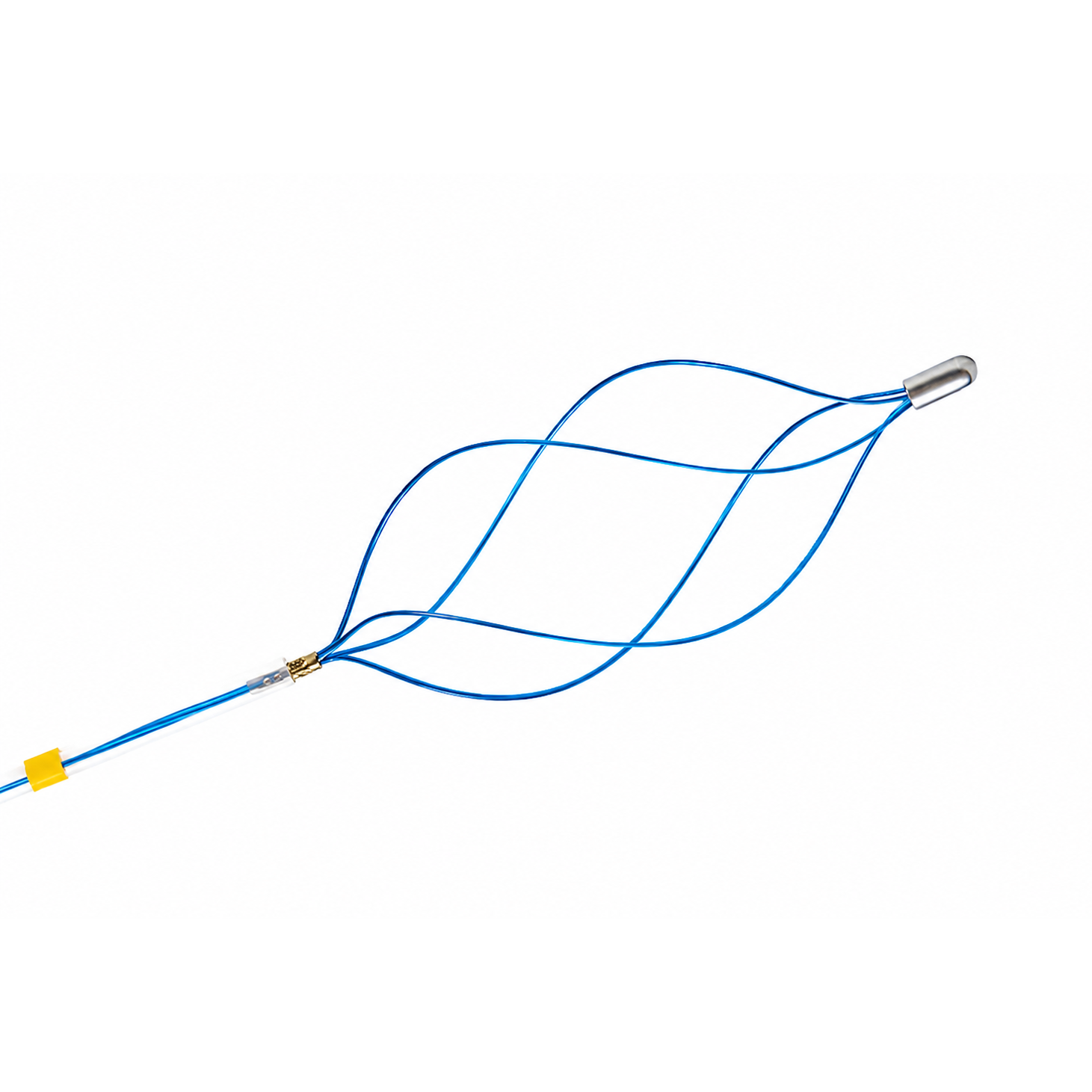
The KINDMED™ Stone Retrieval Basket is a flexible endoscopic retrieval device consisting of a catheter assembly, inner actuation sheath, retrieval basket, and proximal control handle.
The system includes:
- Control handle
- Metallic actuation shaft
- Hub assembly
- Flexible catheter
- Inner sheath
- Retrieval basket
The basket is positioned at the distal end of the device and is controlled by a push-pull mechanism located at the handle. Movement of the handle deploys and retracts the basket, allowing secure capture and retrieval of stones from the biliary tract.
A flushing port is incorporated to facilitate irrigation during the procedure when required.
The device is designed to provide controlled basket opening, stone capture, and extraction while minimizing trauma to surrounding tissue.
Contraindications
Use of the device may be contraindicated in patients with:
- Inadequate pre-procedure fasting.
- Severe inflammation or fragility of the gastrointestinal wall.
- Acute peritonitis.
- Gastrointestinal perforation.
- Intestinal obstruction (ileus).
- Active systemic infection or sepsis.
- Severe cardiopulmonary compromise.
- Uncontrolled bleeding disorders.
- Recent gastrointestinal anastomosis.
- Pregnancy when procedural risks outweigh expected benefits.
The physician should evaluate patient suitability before use.
Potential Adverse Events
Potential complications associated with stone retrieval procedures may include:
- Perforation
- Bleeding or hemorrhage
- Edema
- Basket entrapment
- Basket inversion
- Failure to release captured stone
- Mucosal injury
- Tissue trauma
- Infection
- Procedure-related discomfort
The frequency and severity of complications may vary depending on patient anatomy, stone characteristics, and procedural technique.
Warnings
- Do not use if the sterile barrier or packaging has been damaged.
- For single use only.
- Do not reuse, reprocess, or resterilize.
- Reuse may result in contamination, infection, device malfunction, or patient injury.
- Inspect the device carefully before use.
- Do not use damaged or defective devices.
- Excessive force during stone retrieval may result in device damage or patient injury.
- If basket entrapment occurs, appropriate clinical retrieval techniques should be employed.
- Dispose of used devices according to hospital and regulatory requirements.
Precautions
- The device should be used only by physicians trained in gastrointestinal endoscopy and biliary stone extraction procedures.
- Use only for the indications described in this IFU.
- Avoid excessive torque, bending, or force during manipulation.
- Verify compatibility with the selected endoscope before use.
- Ensure the basket is completely closed during insertion through the endoscope channel.
- Maintain continuous visualization whenever possible during deployment and retrieval.
Instructions for Use
Preparation
- Verify package integrity and expiration date.
- Remove the device using aseptic technique.
- Inspect the basket, catheter, and handle assembly for damage.
- Confirm smooth operation of the opening and closing mechanism.
- Ensure the basket is fully closed before insertion.
Device Placement
- Introduce the device through the working channel of the endoscope.
- Advance the catheter under direct endoscopic visualization.
- Position the basket distal to the target stone.
Stone Capture
- Deploy the basket by advancing the handle control mechanism.
- Manipulate the basket carefully until the stone is enclosed within the basket.
- Close the basket around the stone using the handle control.
- Confirm secure capture before extraction.
Stone Retrieval
- Maintain basket closure during withdrawal.
- Carefully retract the basket and endoscope as required.
- Remove the captured stone from the biliary system.
- Repeat the procedure if additional stones require removal.
Device Removal
- Ensure the basket is fully closed.
- Withdraw the device carefully from the endoscope.
- Inspect the device following removal.
- Dispose of the device according to applicable regulations.
Change in Performance
If the device demonstrates altered functionality, loss of basket control, difficulty in deployment, or inability to perform its intended purpose, discontinue use immediately and determine further patient management according to physician judgment and clinical findings.
Storage Conditions
Store in a clean, dry, and well-ventilated environment.
Protect from:
- Direct sunlight
- Excessive heat
- Moisture
- Organic solvents
- Ionizing radiation
- Ultraviolet radiation
Do not use beyond the expiration date indicated on the package labeling.
Disposal
Following use, the device should be treated as potentially biohazardous waste and disposed of in accordance with hospital, local, state, and national regulations.
Limited Warranty
KINDMED DEVICES PRIVATE LIMITED warrants that this product has been manufactured in accordance with established quality management procedures and applicable manufacturing specifications.
Because storage conditions, transportation, handling practices, procedural techniques, and patient-specific factors are beyond the manufacturer’s control, no guarantee is made regarding clinical outcomes.
The manufacturer’s liability is limited to replacement of defective products. KINDMED DEVICES PRIVATE LIMITED shall not be liable for incidental, indirect, special, or consequential damages arising from misuse, modification, reprocessing, resterilization, or reuse of the device.
Manufacturer
KINDMED DEVICES PRIVATE LIMITED
1st Floor, Plot No. 175B
Dada Nagar Industrial Area
Kanpur Nagar, Uttar Pradesh – 208022, India
KINDMED™ is a trademark of KINDMED DEVICES PRIVATE LIMITED.
