
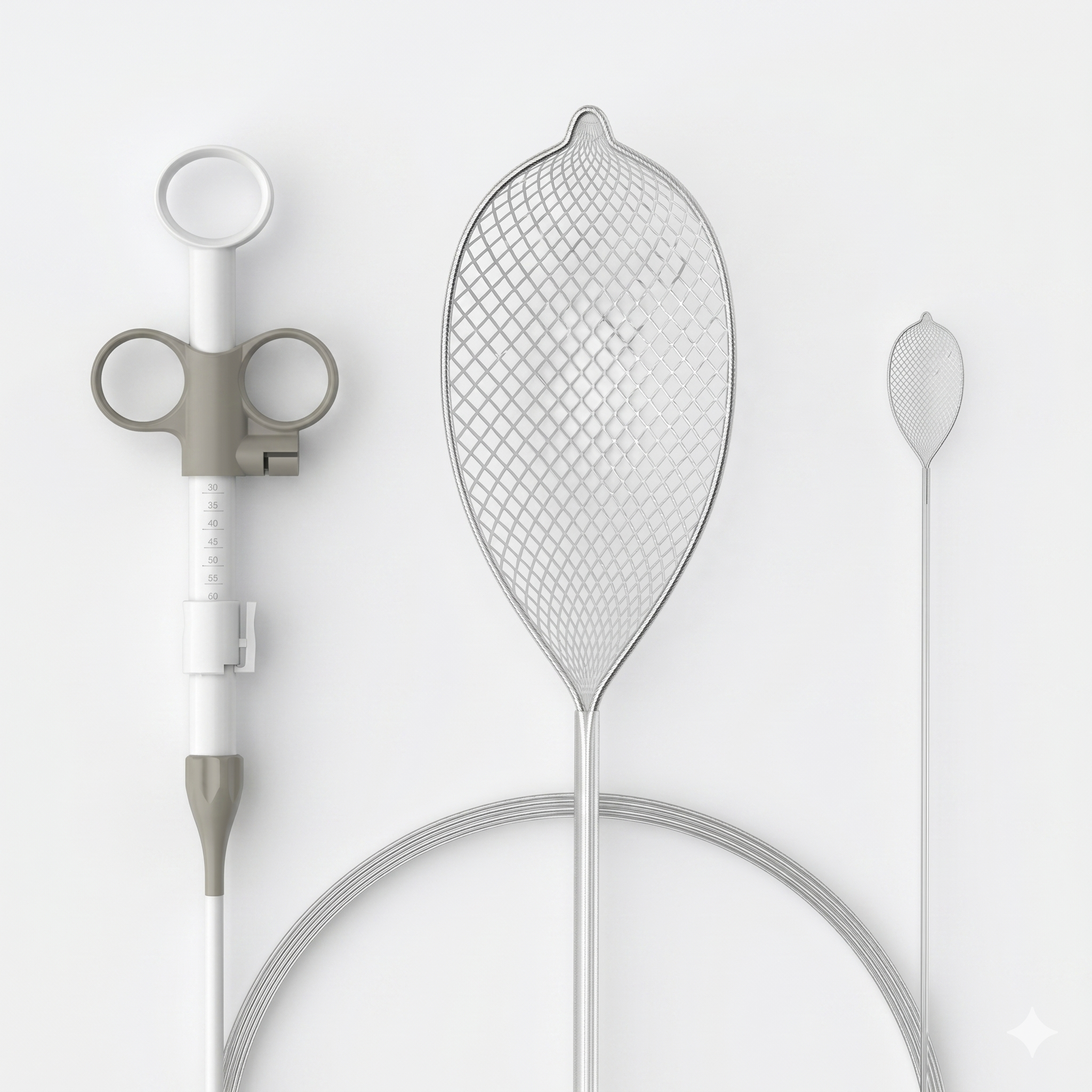
Features:
- Larger opening angle or basket diameter to remove larger foreign bodies
- The disposable grasping forceps’ holder and basket are made of high-quality PTFE coating, which is lightweight and durable
- Easy to insert even in complex locations and flexible to operate
- Ergonomic handle for one-handed operation
- Product connection strength exceeds 50N
| Diameter of Outer Tube (mm) | Length (mm) | Loop net Width(mm) |
| 1.8mm | 1600mm | 15 |
| 1.8mm | 1600mm | 20 |
| 2.3mm | 1600mm | 20 |
| 2.3mm | 1600mm | 25 |
| 2.3mm | 1600mm | 30 |
| 2.3mm | 1600mm | 40 |
| 2.3mm | 2300mm | 20 |
| 2.3mm | 2300mm | 25 |
| 2.3mm | 2300mm | 30 |
| 2.3mm | 2300mm | 40 |
Instructions for Use
Device Description
The KINDMED™ Foreign Body Retrieval Net is a flexible, rotatable endoscopic retrieval device designed to improve capture and retrieval efficiency within the gastrointestinal tract.
The system consists of:
- Slider mechanism
- Control handle
- Heat-shield tube
- Flexible outer sheath
- Retrieval net assembly
The retrieval net is attached to a movable inner wire that is controlled by the proximal slider mechanism. Operation of the slider opens and closes the net, enabling capture and retrieval of foreign objects, food boluses, tissue samples, and excised polyps.
The rotational capability of the device allows improved orientation and positioning at the target site, facilitating accurate retrieval under endoscopic visualization.
The device is available in multiple configurations:
Parameter Specification
Working Length 160 cm, 230 cm
Outer Diameter 1.8 mm, 2.3 mm
Minimum Working Channel 2.8 mm
Contraindications
Contraindications include those generally associated with gastrointestinal endoscopic procedures and situations where retrieval procedures may present an unacceptable clinical risk.
Patient suitability should be determined by the treating physician based on the clinical condition and intended procedure.
Potential Adverse Events
Potential complications associated with retrieval procedures may include:
- Mucosal injury
- Bleeding
- Perforation
- Infection
- Aspiration
- Tissue trauma
- Procedure-related discomfort
- Failure to retrieve the target object
- Unintentional tissue capture
- Obstruction caused by retained foreign material
The incidence and severity of complications may vary depending on patient anatomy, object characteristics, and procedural technique.
Warnings
- Read all instructions carefully before use.
- Use only by healthcare professionals trained in gastrointestinal endoscopy.
- The device is intended for single use only.
- Do not reuse, reprocess, or resterilize.
- Reuse may result in contamination, infection, device malfunction, or patient injury.
- Do not use if the sterile package is damaged, opened, or compromised.
- Inspect the catheter, handle, and retrieval net before use.
- Do not use the device if deformation, kinking, breakage, or other damage is observed.
- Do not use beyond the expiration date shown on the packaging.
- Use the device only for its intended purpose.
- Dispose of used devices and packaging according to institutional and regulatory requirements.
Precautions
- Verify compatibility with the endoscope working channel before use.
- Endoscopic retrieval procedures should only be performed by physicians experienced in therapeutic endoscopy.
- Avoid capturing tissue or anatomical structures not intended for retrieval.
- Apply gentle traction during withdrawal to maintain secure retention of the captured object.
- Excessive force may damage the device or surrounding tissue.
- The device is not intended for retrieval of sharp or cutting foreign bodies.
- If retained material does not release from the net after retrieval, irrigate the net with sterile water or saline rather than using instruments or fingers that may damage the mesh.
- Any use outside the indications described in this IFU is not recommended.
________________________________________
Instructions for Use
Preparation
- Verify package integrity and expiration date.
- Remove the device using aseptic technique.
- Inspect the retrieval net, catheter, and handle assembly for damage or abnormalities.
- Confirm smooth operation of the opening and closing mechanism.
Device Placement
- Introduce the device through the working channel of a compatible endoscope.
- Advance the distal tip under direct endoscopic visualization.
- Position the retrieval net beyond or adjacent to the target object whenever possible.
- Avoid blind advancement through a completely obstructed lumen.
Object Capture
- Open the retrieval net by advancing the slider mechanism.
- Confirm complete net expansion under endoscopic visualization.
- Position the net around the target object.
- Rotate the device if necessary to optimize orientation.
- Close the net gradually to securely capture the object.
- Maintain continuous traction to keep the object secured within the net.
Retrieval Procedure
- Draw the captured object toward the distal tip of the endoscope while maintaining visualization.
- Ensure the object remains securely contained within the net.
- Withdraw the device and endoscope together when appropriate.
- Avoid pulling the captured object into the endoscope channel, as this may damage the device or endoscope.
- Once removed from the patient, open the net to release the retrieved material.
Device Removal
- Confirm the net is fully controlled before withdrawal.
- Carefully remove the device from the endoscope.
- Inspect the device after use.
- Dispose of the device according to applicable regulations.
Change in Performance
If the device exhibits altered functionality, reduced opening or closing performance, loss of rotational control, or inability to perform its intended function, discontinue use immediately.
Further clinical management should be determined by the treating physician according to the patient’s condition.
Storage Conditions
Store in a clean, dry, well-ventilated environment.
Protect from:
- Direct sunlight
- Excessive heat
- Moisture
- Organic solvents
- Ionizing radiation
- Ultraviolet radiation
- Corrosive environments
Do not use beyond the expiration date indicated on the product label.
Disposal
Following use, the device should be considered potentially biohazardous and disposed of in accordance with hospital, local, state, and national regulations.
Limited Warranty
KINDMED DEVICES PRIVATE LIMITED warrants that this product has been manufactured in accordance with established quality management procedures and applicable manufacturing standards.
Because storage conditions, transportation, handling, procedural techniques, patient-specific factors, and other variables are beyond the manufacturer’s control, no guarantee is made regarding clinical outcomes.
The manufacturer’s liability is limited to replacement of defective products. KINDMED DEVICES PRIVATE LIMITED shall not be liable for incidental, indirect, special, or consequential damages arising from misuse, modification, reprocessing, resterilization, or reuse of the device.
Manufacturer
KINDMED DEVICES PRIVATE LIMITED
1st Floor, Plot No. 175B
Dada Nagar Industrial Area
Kanpur Nagar, Uttar Pradesh – 208022, India
KINDMED™ is a trademark of KINDMED DEVICES PRIVATE LIMITED.
