
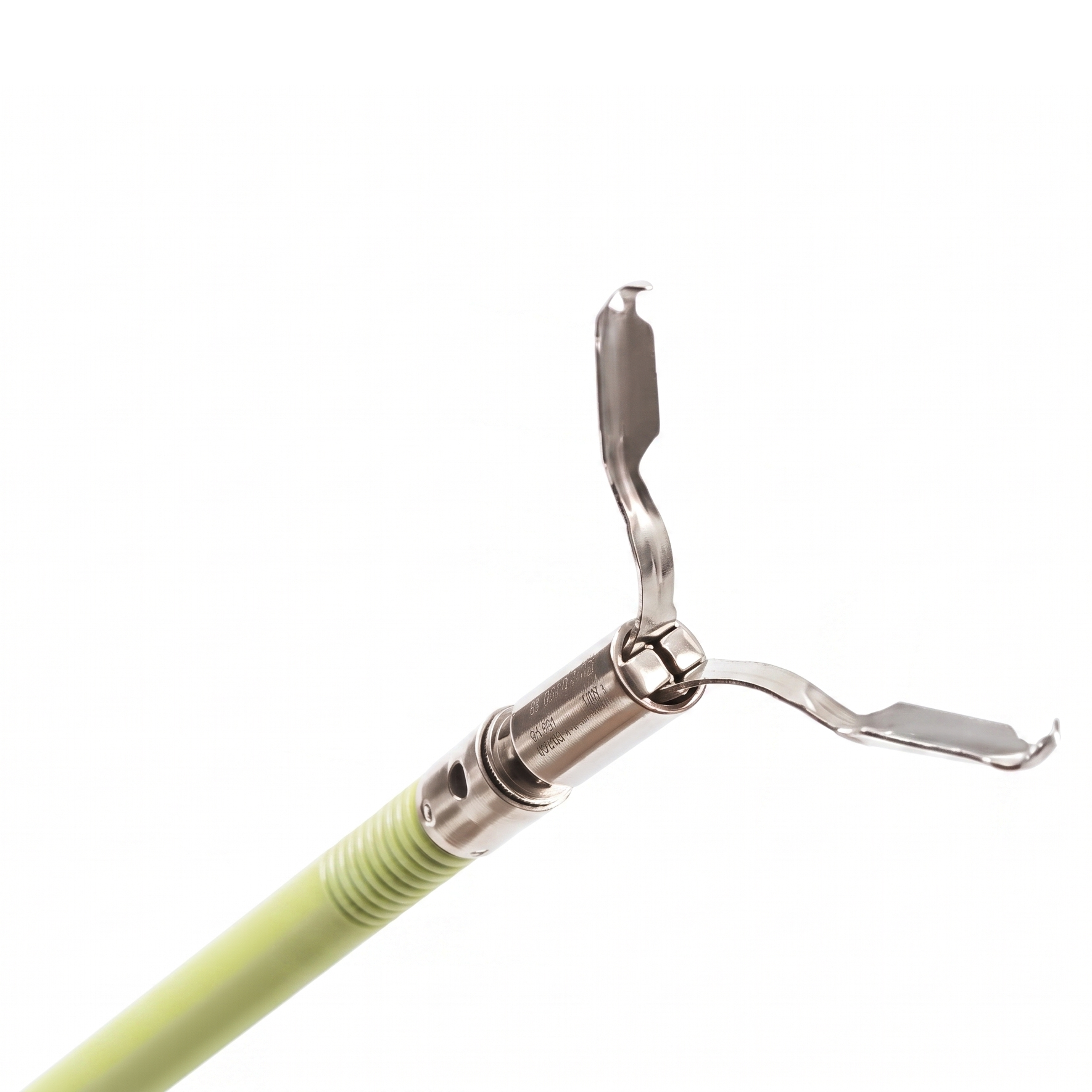
| Working length (mm) | Min. working channel (mm) | Max. clip O.D. | Opening Span (mm) | Jaw tip angle | Rotatable (Y/N) | Repositionable (Y/N) | Removable (Y/N) | Coated (Y/N) |
|---|---|---|---|---|---|---|---|---|
| 2300 | 2.8 | 2.6 | 9 | 90 | Y | Y | Y | Y |
| 2300 | 2.8 | 2.6 | 9 | 135 | Y | Y | Y | Y |
| 2300 | 2.8 | 2.6 | 11 | 90 | Y | Y | Y | Y |
| 2300 | 2.8 | 2.6 | 11 | 135 | Y | Y | Y | Y |
| 2300 | 2.8 | 2.6 | 13 | 90 | Y | Y | Y | Y |
| 2300 | 2.8 | 2.6 | 13 | 135 | Y | Y | Y | Y |
| 2300 | 2.8 | 2.6 | 16 | 90 | Y | Y | Y | Y |
| 2300 | 2.8 | 2.6 | 16 | 135 | Y | Y | Y | Y |
| 2300 | 2.8 | 2.6 | 11 | 135 | Y | Y | N | Y |
| 2300 | 2.8 | 2.6 | 13 | 135 | Y | Y | N | Y |
| 2300 | 2.8 | 2.6 | 16 | 135 | Y | Y | N | Y |
Instructions for Use
Intended Use / Indications for Use
The KINDMED™ Endoscopic Hemoclip is intended for endoscopic placement within the gastrointestinal tract for tissue approximation, endoscopic marking, and mechanical hemostasis.
The device may be used for:
- Endoscopic marking of anatomical landmarks or lesions.
- Hemostasis of bleeding gastrointestinal ulcers.
- Closure of mucosal and submucosal defects measuring up to 3 cm.
- Hemostasis of blood vessels up to 2 mm in diameter.
- Management of polyps measuring up to 1.5 cm in diameter.
The device is supplied sterile and is intended for single-patient use only.
Device Description
The KINDMED™ Endoscopic Hemoclip is an endoscopic clipping system designed to facilitate tissue approximation and bleeding control within the gastrointestinal tract.
Disposable Endoscopic Hemoclip
The disposable clip system consists of:
- Control handle
- Slider mechanism
- Flexible catheter
- Internal actuation wire
- Distal clip assembly
The catheter incorporates a control wire extending from the handle to the clip located at the distal end of the device. The clip is designed to provide secure tissue capture and retention following deployment.
The handle mechanism provides controlled rotation and clip manipulation, enabling accurate positioning during endoscopic procedures. The clip can be opened, repositioned, and closed prior to final deployment. Once released, the clip remains attached to the target tissue while the delivery system is withdrawn.
The device provides 360° rotational capability for improved access and precise clip orientation.
Disposable Clip Cartridge
The disposable clip cartridge contains a single sterile clip intended for use with the reusable clip applicator.
Following deployment, the clip remains attached to the tissue while the applicator may be reloaded with an additional compatible clip cartridge if required.
________________________________________
Contraindications
The device should not be used in the following situations:
- Mucosal or submucosal defects exceeding 3 cm.
- Polyps larger than 1.5 cm in diameter.
- Blood vessels larger than 2 mm requiring treatment.
- Patients who are unable to tolerate endoscopic intervention.
- Patients with severe gastrointestinal narrowing preventing safe endoscope passage.
- Patients with significant coagulation disorders.
- Patients with known hypersensitivity to device materials or medications associated with the procedure.
Potential Adverse Events
Potential complications associated with endoscopic clipping procedures include, but are not limited to:
- Perforation
- Bleeding or hemorrhage
- Aspiration
- Fever
- Infection
- Allergic reactions
- Hypotension
- Respiratory depression
- Cardiac arrhythmias
- Temporary dysphagia
- Aspiration pneumonia
Warnings
- Read all instructions before use.
- Use only by healthcare professionals trained in therapeutic endoscopy.
- For single use only unless specifically identified as reusable.
- Do not reuse, reprocess, or resterilize disposable components.
- Do not use beyond the expiration date.
- Do not use if the sterile barrier or packaging is damaged.
- Inspect the device before use and discard if damaged.
- Monitor the patient for possible rebleeding following treatment.
- Exercise caution when clipping fibrotic or hardened tissue.
- Emergency surgical intervention should remain available if unexpected complications occur.
- The clips contain metallic components and should not be used in patients with severe metal hypersensitivity.
Precautions
- Review the Instructions for Use before performing the procedure.
- Verify compatibility with an endoscope having a minimum working channel of 2.8 mm.
- Introduce the device only when the clip is in the closed position.
- Excessive force during advancement may damage the device or endoscope.
- Passage through highly tortuous anatomy may affect device performance.
- Ensure proper tissue capture prior to clip deployment.
- Users should be familiar with endoscopic hemostasis techniques and clip deployment procedures.
Instructions for Use – Disposable Endoscopic Hemoclip
Preparation
- Open the sterile package and inspect the device.
- Remove the device from the protective packaging.
- Confirm that the clip is fully closed.
- Introduce the device through the endoscope working channel.
Positioning and Deployment
- Advance the clip to the target site under endoscopic visualization.
- Open the clip gradually using the slider mechanism.
- Rotate the handle as needed to achieve optimal orientation.
- Position the clip over the target tissue.
- Close the clip to capture the tissue.
- Verify adequate tissue engagement.
- Deploy the clip by actuating the release mechanism.
- Withdraw the delivery catheter after successful deployment.
The clip may be repositioned multiple times prior to final release.
Instructions for Use – Reusable Applicator with Clip Cartridge
- Inspect the reusable applicator and clip cartridge before use.
- Connect the clip cartridge to the distal end of the applicator.
- Load the clip according to the operating mechanism.
- Insert the loaded device through the endoscope channel.
- Position and deploy the clip using the same procedure described for the disposable clip system.
- Additional clips may be loaded as required during the procedure.
MRI Safety Information
This device is classified as MR Conditional.
Patients with implanted clips may undergo MRI examinations under the following conditions:
- Static magnetic field strength: 1.5 Tesla or 3.0 Tesla
- Maximum spatial gradient field: 2900 Gauss/cm
- Maximum whole-body averaged SAR: 2.0 W/kg
Under these conditions, the expected maximum temperature increase is approximately 2°C after 15 minutes of continuous scanning.
Image artifacts may occur in the vicinity of the clip during MRI procedures.
Storage Conditions
Store in a clean, dry, and well-ventilated environment.
Avoid exposure to:
- Direct sunlight
- Excessive heat
- Moisture
- Organic solvents
- Ionizing radiation
- Ultraviolet radiation
Disposal
After use, the device should be treated as potentially biohazardous waste and disposed of in accordance with hospital, local, and national regulations.
Limited Warranty
KINDMED DEVICES PRIVATE LIMITED warrants that this product has been manufactured in accordance with established quality standards and manufacturing procedures.
The manufacturer’s responsibility is limited to replacement of defective products. No warranty is provided regarding clinical outcomes, as device performance may be affected by storage, handling, procedural techniques, and patient-specific conditions beyond the manufacturer’s control.
The manufacturer shall not be liable for incidental, indirect, or consequential damages arising from misuse, modification, reuse, or improper handling of the product.
Manufacturer:
KINDMED DEVICES PRIVATE LIMITED
1st Floor, Plot No. 175B
Dada Nagar Industrial Area
Kanpur Nagar, Uttar Pradesh – 208022, India
KINDMED™ is a trademark of KINDMED DEVICES PRIVATE LIMITED.
